Thursday, November 24, 2005

Melbourne, Toad Hall, St. Kilda, koalas, kangaroos and Penguins


How's that for a name for a post?
We got into Melbourne, took a bus to our hostel....but unfortunately they had booked us into a room with a queen bed, and althought I like Sandy....no way. We finally found a small backpacker's in a wonderful old house called Toad Hall. The owner had been a frog nut and there were statues all over the first floor...even the keys were frog green. Upstairs our room was huge, and had it's own private bathroom. High ceilings with carved plaster moldings, fireplace, crown moldings...wonderful. Wonderful outdoor garden right in downtown Melbourne. Unfortunately they only had 2 nights available. Sandy and I booked a trip for the second day, and we left 2 bags each in their storage room, and took an overnightcase with us. She went to the Great Ocean Road; I went to Phillips Island. The trip took about 6 hours, because we stopped several times. First at a wildlife rescue/ preserve where we saw wombats, koalas, wallabys and kangaroos. Wonder of wonders, I got another picture of a mother with it's joey 's head visible...to compensate for the one I lost in Melbourne. We went to a place overlooking the ocean where there were hundreds of seagulls nesting. The chicks went from just hatched to nearly grown. We had dinner at the YHA in Phillips Island...horrible, not your real Thanksgiving dinner. We got to the Penguin Parade place about 8PM and walked down to the viewing stand. WHen the tiny (blue/fairy) penguins decide to come out of the ocean to their nests to feed their babies, they accumulate into bunches of 20 or more (protection from the seagulls who sometimes get luck and prey on them). Then they start to waddle across the sand, By the time they get to the viewing stand, they are on their way, and seemingly not at all bothered by human onlookers (who are not allowed to film/photograph them and scare them with flash). We saw about 100, each one cuting then the last. On our way back to the bus the stragglers were walking alongside the walkway nearly keeping pace with their human viewers.
It was just magic! En route home I got dropped off at the Base Hostel in St. Kilda...a small suburb on the beach! Wonderful walking, but not many shells. We got back around 12, and on
Friday I slept really late! Then I trammed downtown, took the free bus that circles the downtown and went to the Melbourne Museum. They had a great aborigine exhibition called 2 Laws. I saw Ned Kelly's armor suit, and an exhibition of water/rainforest which deals with the Melbourne water ecosystem and where there water comes from.

Sunday, November 20, 2005

In Search of the Yellow Eyed Penguin and More


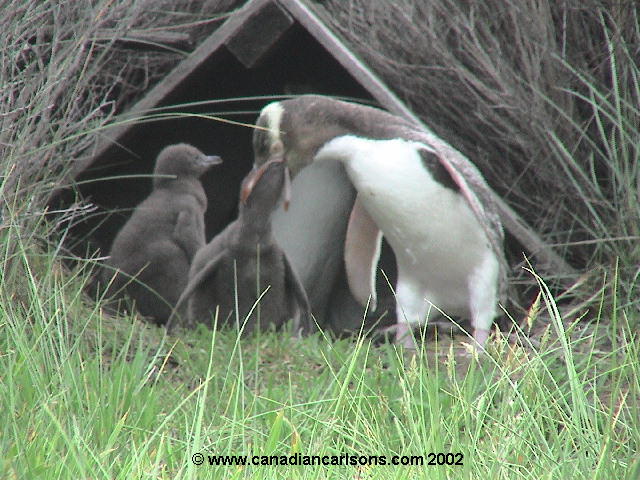
The yellow eyed penguin, the world's third largest, is an endangered species, with only about 5,000 animals remaining. It's found only in New Zealand and the islands around Antartica. It prefers to nest in the woods, but unfortunately, most of its habitat has been cut down. Being a flightless bird, it had no natural enemies. However, with the importation to New Zealand of stoats, possums, dogs, and rats, the penguin and its eggs are threatened with extinction.

Penguin Place, an organization trying to rescue this interesting bird, is on the Otago Peninsula, outside of Dunedin. We decided to rent a car and drive out to have a look around. Triangular wooden nests have been built into the hillside and now there are 15 nesting pair of penguins, plus several non nesting birds. We were fortunate to have arrived when the chicks were only 3 weeks old. They are protected from tourists by tunnels and blinds, and nobody is allowed to talk or take photographs with flash. Penguin Place is planting native trees and bushes in an attempt to bring the habitat of the Yelloweyed Penguin back to what it once was. And, they have an active predator control program to protect the birds. While we wre there we saw several small blue penguins, but since they build their nests into the hills, it was difficult to see both the parent and the baby.

The road out to Penguin Place runs along the water and its VERY narrow and windy. Since my driver's license was stolen in Sydney, we rented a car and Sandy drove. The weather was perfect. We stopped for lunch at the Royal Albatross Sanctuary, where we learned about this amazing bird, which flies for months at a time, and has a wingspan of about 8 feet. The birds were just starting to nest, and are very skittish the first week, so the nesting area is closed until next weekend. However, we were fortunate enough to see 2 of the birds fly overhead over the cliff tops...they are gigantic and glide without flapping their wings.

On the way home we stopped at a small beach, and there was a HUGE male fur seal sleeping on the rocks about 10 feet in front of us, and another smaller one swimming around in the water offshore. At a roadside stand we bought some lovely paua shells, (used by everyone in New Zealand to make wonderful jewelery. They are like abalone shells, but much brighter with dark green, blue and purple) and marvelled at the flowers, both wild and in gardens along the way.

It was a totally perfect day!

Australian and New Zealand Hostels are Fantastic


When we decided that we were going to spend most of our time on this trip in hostels, frankly, I was a little leary. I imagined being jammed into a crowded, dirty room with 6or more 18+ year olds who were in total shock at sharing a room with 2 "seniors". Instead, the YHA and most other hostels here are clean, centrally located, friendly and have such extras as swimming pools, a hot tub, free meals, free sightseeing tours, and a gourmet cafe. There is a lounge with TV, and several have video lounges with huge libraries of DVDs to watach. All have washers and dryers. There is a book exchange so you don't have to carry gobs of reading material. Most have nightly activities for guests which could be a free BBQ, movie marathon, whatever. All have internet, and most have a travel agency. One Australian Hostel, Base, has a female only floor called the Sanctuary. The bathrooms, a big concern, are totally spotless, and gender segregated. The kitchens, where you can prepare your own meals if you choose, typically have 2 refrigerators, 2 sinks, a large food prep area, 2 large stoves, toaster ovens. toasters, microwaves, silverware, knives and other utensils, and plates, cups, glasses etc. Most have a special place which dispenses boiling water for tea, or coffee. There are lockers and luggage storage, if you are going away for a few days but returning. Several times we have stayed in apartments that cater to backpackers; the two pictures bordered in green show one in Port Douglas, Australia.
A twin room costs about $25-45 per person a night, splitting the cost. Living in a dorm is cheaper; javing a private bath makes it more expensive. And, you meet interesting people, which is one of the best things about it.

Try it... you'll like it!

Friday, November 18, 2005

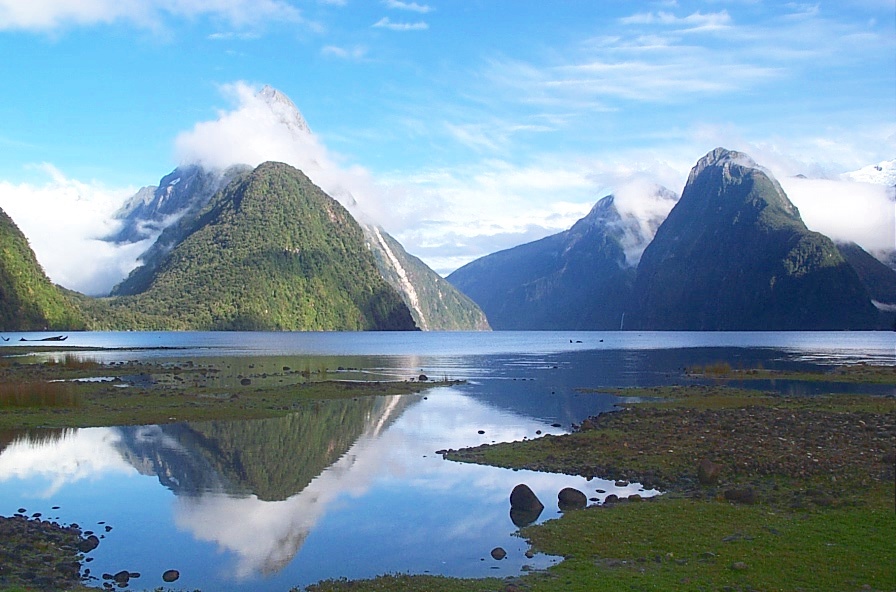
Milford Sound via the Milford Wanderer


This is mostly going to be a picture blog...because there are no words to describe the sound. The trip was wo nderful. We saw a perfect rainbow that spanned the sound, man many bottle nosed dolphins, some penguins and even some fur seals trying to jump up onto the rocks.

Te Anu and the drive to Milford Sound... New Zealand's most amazing scenery!


Te Anu. The bus trip from Dunedin got more and more exciting as the flatness of the land gave way to hills, and finally snow covered mountains in the distance. All along the way millions and millions of sheep were contentedly muching away in the fields. Not to mention cows and deer.
Anyhow when you come into Te Anu you drive down the main street which has a flowered and palm tree lined median, interesting shops, and dead ahead, the lake, which is ringed all around by mountains, many of which had snow, despite the mild winter this year. There is a paved path along the lake side, with amazing views of the water and mountains.

Many people come to Te Anu because it's the start of the Milford Treck, one of the lovliest of the NZ treks that people from all over the world come to make. There are many 307+ day trecks in this area, and we met a lot of the "treckkies" in the hostel. We, however, came first for the ride, and then for the overnight cruise on the Milford Sound. The trip to Milford by bus takes about 2 hours, and it, too passes snow covered mountains with meandering streams bordered by every colored lupen imaginable and hills covered with sheep and lambs.

Waterfalls, trees covered with the NZ version of Spanish moss, the continental divide and countless switchbacks with a view in every direction....You name it, it's here.

Tuesday, November 15, 2005

Surprising Dunedin


After a 6 hour gorgeous (running along the Pacific) but long trip. I got to Dunedin on the 27.

Normally I'm not a shopper, but I found a wonderful bargain in wool, which I sent to the US today along with the wool I bought in Rotoruoa. Lots less to carry and pay overweight on when we head back to Australia (small airlines here have smaller fares, but have smaller weight allowances). I'm leaving today by bus to Te Anau, and then from there to Milford Sound.

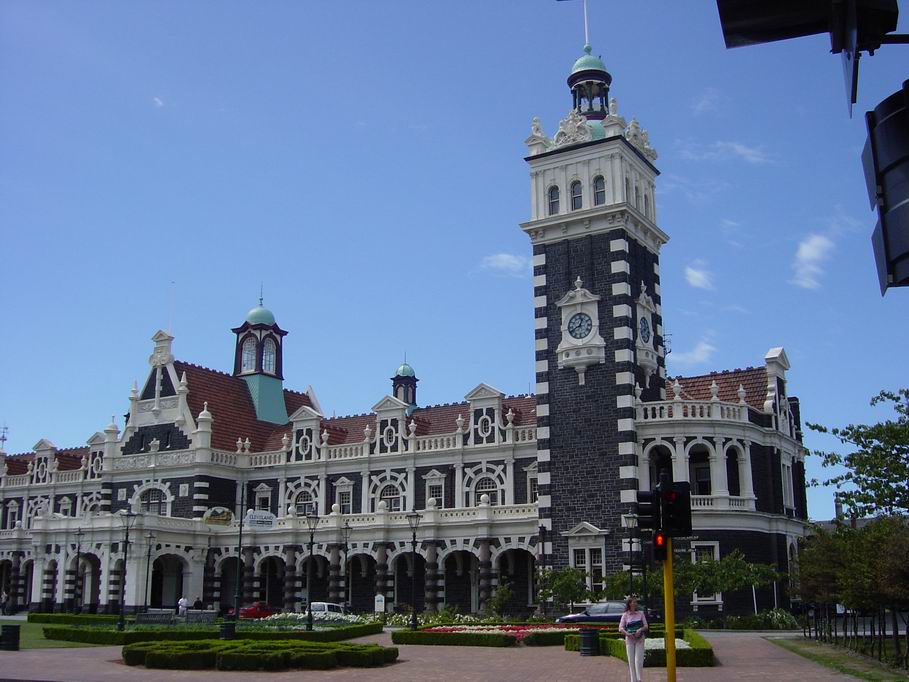
Dunedin is a sweet city. It was founded by Scottish immigrants, and they built wonderful buildings and the first university in New Zealand. The big building is the train station, which is no longer used. Originally it was going to be torn down, but it was saved and now is owned by the city.

The center of the city if in the form of an octagon, with streets radiating out. It's hilly, has a lovely harbor and beautiful Victorian houses in a city which is navigatable on foot and bus.

Gotta sign off and get my bag from storage and some last minute black fly (sand fly) repellant. It's beautiful there but allegedly the insect life is TERRIBLE.

Saturday, November 12, 2005

Akaroa the Beautiful, Part 2


Since I'm leaving Christchurch tomorrow AM, I decided to take a bus trip to the picturesque town of Akaroa, this sits on the crater of an extinct volcano. The trip there was lovely. Beautiful green pastureland and foothills; vineyards, wildflowers (yes, more lupins of all colors), even lavender farms.

This trip turned out to be special for me. First we went to a beach and looked for interesting stones and shells; then our guide took us to see the small museum in the home of a man who's lived there for 30 years and has collected rocks, fossils and shells...polishes them, sells them, decorates his yard with them. It was really interesting.

The trip continued with a short stop at a local craft shop and then at a dairy that made the most delicious cheese. The road winds uphill until it reaches the top of the volcanic crater, and from there it descends along the side to the village on the shoreline of the lake that was formed after the volcano collapsed, formed a crater, and the ocean rushed in.

This place was the scene of many battles between the more warlike Maoris from the North Island and the more nomadic Maoris of the South Island. Since at that time the Maoris were canibals, there was probably a lot of feasting going on there.

The French explored this part of the South Island, loved it, went back to France and brought a ship full of French settlers and a French warship. Unfortunately for them, the English and the Maoris had just signed a peace treaty making the land of New Zealand part of the British Empire. The French settlers were given the option of staying or settling in Samoa, which was a French possession. To make a long story short, they decided to stay, and many of the streets of the town have French names. The houses are mostly made of wood, painted colorfully, and have a wonderful view of the harbor on one side and the green mountainsides on the other. It's a truly beautiful place.

Many of the old houses have been turned into shops, There are a lot of gardens full of the largest and most fragrant roses I've ever seen. In one of the parks along the harbor amongst the other plants were several huge artichoke plants with lots of artichokes just sitting there. When I pointed them out, nobody in our group had either eaten or liked them, so perhaps that's why they haven't been picked.

En route home, our bus had a flat tire, so we had to be rescued by a second bus. Not as dramatic as the man who had a heart attack (and died) on our last train trip, but still a little out of the ordinary.

Thursday, November 10, 2005

TranzScenic from Kaikoura to Christchurch, then from Christchurch to Greymouth and back


The day after my physiotherapy in Kaikoura I was expecting my back to be all fixed....WRONG!
Sandy, again, had to drag the luggage around in the station...luckily the taxi drivers are very helpful so it wasn't too bad. This next part is about the train trip between Kaikoura and Christchurch.

The routes of the New Zealand TranszScenic are reputed to be some of the most beautiful in the world, and it's true. My first trip, from Wellington to Kaikoura, followed the coastline, and went between the mountains and the beautiful Pacific. Sometimes the track was only a few feet from the edge of the clif. The view was just spectacular. In other areas, huges areas of vineyards filled the land on both sides of the train...the Kiwis are really serious about their wines. I didn't think it could get better than that, but I was wrong.

Today we left the hostel, where Sandy and I had our own rooms for the first time (heaven! My first TV in 5 weeks, a solar pool, a great games room, internet cafe, etc.). It's great. Anyhow, we left here at 7:15, and got to the train station about 8AM where we checked in and got our boarding passes. I was fortunate enough to sit across from a woman from Northern New Zealand who lived on a farm, raised prize cattle, and was driving down to the South Island to babysit people's farms if they wanted a break from the work. She has a 5th wheel, an electric fdence to keep the animals away from her truck....but I digress. It was interesting beacause she was a treasure trove of information about the plant life and geology of the region.

First, just a word about Christchurch. It's a VERY English city, with all English Street names, and the River Avon flowing through the center. It's called the garden city because of all the trees and flowers...most of which were imported from England. More about this later.

Anyhow, the train travels through the Canterbury Plains, which is where there are a LOT of sheep, and cows, and even deer (in the North Island, they raise a lot of deer for venison). The train travels uphill until it gets to the continental divide at a place called Arthur's Pass. Well, the train made an unanticipated stop along the way because someone had a heart attack on the train , had to be ambulanced off, and later died. This made the train very late. I was taking pictures in the observation car and couldn't hear the announcement about how long the train was stopping at Arthur's Pass. I just rushed into my car, and grabbed my purse (which was being guarded by Noeline, the farmer lady). I got off the train like everybody else, and then just followed the people down into the National Park. There was a really interesting parrot walking around on the ground and I stopped to photograph it. Well, as I looked up, I saw the train pulling out of the station and I was a LONG way away. You have never seen me run as fast as I did then...my back was completely healed. Anyhow, they just kept on going. I walked back into the parking lot where there were 2 tour buses. I asked if the first one was going to Greymouth, and they weren't. The second one, which was a Chinese chartered tour bus, had a seat and was going to Greymouth. To make a long story short....we played "Follow that train!" The entire bus was laughing at me, but I didn't care. The train was in this 7kilometer long tunnel and we were on the road, so we couldn't be sure where it was. We finally caught up to the train at the next scheduled stop (2 minutes). I jumped off the bus, ran over to the train, opened the door and hauled myself up those steps...Success! It was quite an adventure! The funny thing is that the train is divided by the observation car, which has in the center, the compressor for the ventilation system of the train. I jumped on at the rear of the train and had to find a conductor to open up the compressor room so I could pass to the front of the train where I had been before. I finally sat down beside Sandy and we just laughed and laughed. It was quite an adventure.

The trip itself was amazing. The fields were absolutely covered with yellow scotch broom, wild lupins (purple, white, pink and yellow) buttercups; palm trees in bloom...the colors were incredible. I've been trying to grow lupens for 3 years in my garden and here they grow wild in abundance and pristine glory.

Passing the continental divide the climate changes completely. On the Pacific side, there is a lot of rainfall and things are very green; on the eastern side there is less than 1/20 as much rain and things are very dry. The bus driver told me they had a very warm winter, so there was snow only on a few of the peaks, and the runoff into the rivers was really low.
This train passed a lot of places where people looking for gold mined, and there are still mining operations going on for coal....we stopped several times to make room on the track for coal trains. The train, with a series of 21 tunnels and several very high tressels, climbs over the Snowy Mountains, and ends the trip in Greymouth. On the way you pass over deep canyons and have snowcovered mountain caps on either side of the train along the way.

Greymouth is a sweet town with a wild west flavor. It We stayed there less than we normally would have, but we'd lost a lot of time when the train stopped for the person who'd needed to be taken off. It's the largest town on the west coast of the South Island, but only has a population of about 5,000. was the center for the early mining in the Snowy Mountains.It's the main trading center for all the small communities around it, so has a lot of stores and restaurants and even a hostel in an old mine building. Speaking of wild west, something I didn't know but which I've enjoyed hearing about is the fact that New Zealand has it's own Country and Western music scene, the kiwi version of grammys, and it's pretty popular. In the taxibus on the way back from the train station there was a lot of yodeling and down home singing.

Back at the Stonehurst Accomodation, the first time in the trip when Sandy and I each had our own room, things are wonderful. Last night I had my first TV fix in 5 weeks, and of all things, it was a rerun of a Monk show I'd seen a couple of years ago. Tonight I plan on taking a long hot shower and crashing...it was about 9 hours on the train today, and with my little adventure, you can believe I'm tired!

Tuesday, November 08, 2005

Dolphins in Kaikoura, pt. 2


Hi! Since the last time I wrote my back improved slightly, so I could go as a spectator, not a swimmer (sniff). It was a perfect day...sunny, calm sea and lots of dusky dolphins and their babies. Some were less than a week old. They are small but very active, jumping, doing backward flips, skating along out of the water on their tail. Today the boat captain estimated that we saw over 200, and I think that's about right.
What an incredible experience!

After lunch I went to the local hospital where the physiotherapist did accupuncture and massage on my back...and hopefully that will be the end of that. Just to remind me that paradise has a few blemishes (Kaikoura really seems like paradise), the right temple broke off my glasses. Fortunately I had brought another pair, and a pair of clip ons which serve as substitute sunglasses for the ones I had with me in my purse when it was stolen.

We leave for Christchurch tomorrow afternoon. On to another new adventure.

Monday, November 07, 2005

Dolphins at Kaikoura


Today Sandy and I'd planned to swim with dusky dolphins at Kaikoura. However, with my back in unresolved spastic state (that's only the BACK) and the winds at 20 knot per hour, we decided to reschedule til tomorrow AM, and hope that the weather will be calmer. I will still only watch...which is disappointing, but still supposed to be spectacular. In the afternoon I have an appointment with a massage/accupuncturist to get the spasm under control. I'm including pictures of the dolphins and whales that have made Kaikoura famous as well as its spectacular scenery. Wish us luck! This is the reason we came here, so I hope the weather and my back will cooperate.

Ferry and Tranzscenic Train From Wellington To Kaikoura


Yesterday was amazing.

We took the ferry from Wellington at the southern end of the North Island to Picton, at the northern tip of the South Island. The trip takes about 3 1/2 hours, and is rated one of the more beautiful ferry rides in the world. I would have to concur. The water is always either dark aquamarine in the channel, to light turquoise near shore.

Once we landed, we took a taxi and our luggage to the train station where we boarded the New Zealand TranzScenic train from Picton to Kaikoura. The train runs along the water, so you have mountains on one side, and the Pacific on the other. And fields of wild flowers (yellow lupens, scotch broom, and poppies), and rivers. And tunnels (23) and sheep with their baby lambs. After 3 1/2 hours we stopped at Kaikoura, which bills itself as The Place Where the Mountains Meet the Sea. Again...wow! It's hard to imagine palm tree fringed ocean and snow covered mountains existing in the same place, but they do at Kaikoura.

The day before we left I somehow threw out my back, which was is constant spasm, despite all kinds of muscle relaxants and pain pills, for 24 hours. I was scared to death that I wouldnt be able to get out of bed at the hostel and get on the ferry. Somehow, some way I was able to make both trips before the spasm started again (and even take pictures from the Observation Car of the train ...am empty car with guard rails for people who want to capture the amazing view on film). We got to our hostel, and our room, which turned out to be about 8X8 feet, no joke. When I tried to get up this AM (sad to say the spasm had returned) there was no place to put my feet, so it took about 5 minutes of maneuvering to finally stand up.

Saturday, November 05, 2005

Genetic Engineering and Guy Fawks day fireworks


Yesterday, Saturday, after some exploring of shops nearby, I went back to the Te Papa Museum. They have so many amazing hands on exhibits. I tried my hand at simulated sheep shearing...you were supposed to finish the sheep (plastic covered, with numbered stroke marks indicating where the shears were supposed to go) in 2 minutes. It took me over 4, and you had to turn the sheep around, try not to shear too deeply. I have a much greater respect for the shearers I'd seen on TV that make it look so easy.

There was another fascinating exhibit on DNA, genetic research with it's moral and political issues, genetically altered foods, and the question of whether a country like NZ, which has chosen consciously to be "green", should consider genetically altered foods or genetic research.
The Maori have a strong belief in the oneness of the universe (think Zen) and are opposed for religious and cultural reasons. Both sides were presented, and there were 4 online questionairs to fill out responding to many questions that genetic engineering pose. The highlight of this exhibit for me was the chance to culture visible DNA in a laboratory they had set up there.
I can't tell you the scientific explanations of what happened, but the procedure went something like this. We were divided into small groups, and donned sterile gloves. Each of us received a graduated test tubs, which we first filled with 5 cc of strawberry puree. We then added a dollop (there was a lot of discussion about what that meant) of kiwi puree and stirred gently for 5 minutes. After that we added about 4cc of some sort of alcohol without stirring or disturbing the mixture already in the tube. After about 4 minutes, small transluscent strands of strawberry DNA rose into the alcohol...those were the strawberry DNA. The laymen's explanation was that kiwi breaks down protein...which is why it's used as meat tenderizer. It was a very interesting experiment!

In the museum is a copy of the treat of Waitangi, which the English and the Maori signed as a peace treaty in 1840. Also were the English and the Maori translation of what it said. Then there was a second, Maori translated version of that the Maori signed, which was significantly different from the original one, which was done by an Englishman. There is a lot of controversy here about how valid a treaty can be if one of the parties doesn't know what they're really signing.

In the evening, November 5, NZ, Auastralia and Great Britain celebrate the failed attempt of English catholics, who were being persecuted under James 1, to blow up the Houses of Parliament. The most famous person responsible was Guy Fawks, and this evening is marked by huge firework displays. In Wellington, they are exploded at the harbor, and since the YHA hostel is right next to the harbor, I joined the hoards walking down for a great view of a wonderful display of fireworks. Even the supermarket was selling fireworks, and there were many people in the crowd and nearby who were shooting off their own. It was casual, fun, and I suspect, very New Zealand.

Thursday, November 03, 2005

Wellington/ Te Anu Museum


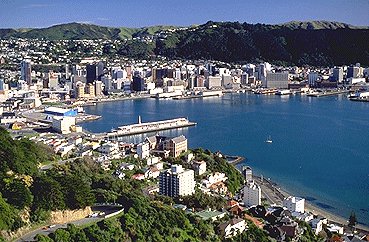
After a fantastic breakfast in Rotoroa I left for Wellington. Another somewhat larger turbo prop...I really like smaller planes. Anyhow, the flight took about an hour. Coming into Wellington you pass over some wonderful mountain ranges, then suddenly see the city before you and the dark turquoise/royal blue water...it's beautiful.

The Wellington YHA is 2 blocks from the water and the Te Anu Museum, which is one of the things I most wanted to see in NZ. I spent about 2 1/2 hours there today and just barely scratched the surface. There is so much I don't know about Pacific Island culture, and this is possibly the best museum of it's kind in the world.

Wednesday, November 02, 2005

Possums and Sheep


Here's a weird thing. Over a hundred eighty years ago, since there were no native mammals (aside from large bats) someone decided to import a really ugly possum to use for a fur industry. Well, as so often happens when you play with an ecosystem, the possum population exploded, and nobody wanted possum fur.

Problem: what to do with all those ugly possums.
Solution: disguise their ugly fur by spinning it into the lovely New Zealand wool. It's called "possum down"
It's hard to find 100% wool anything here; everything has possum fur in it.
I went into a yard store yesterday and had trouble finding just plain merino wool. The woman said "Most you Americans and Canadians don't like the other kind of wool." I I explained, for me at least, that wool is a renewable resource, while to get possum fur you had to kill the possum.

Solution: create the myth that possum is a delicious delicacy... and maybe soon people the world over will be wanting NZ possum as well as lamb. They better hurry fast...there are now 20 possums for each person in NZ.

Rotorua Land of Geothermal Lakes, mud and geysers


After a short flight (Beechcraft 2 engine turboprop; each of the 20 seats was a window seat) from Auckland I landed at the teenie tiny Rotorua airport. Their baggage delivery system is they drive the luggage cart outside the front entrance and you grab yours.

On the web, ourmotel looked and sounded great. In reality it's a little different. Their heated pool is just a little bigger than the rooftop hottub at the XBase Hostel in Auckland. We had to change rooms because the beds were trampolines in disguise...a sure cause of a big back problem for me. The continental breakfast consists of envelopes of instant coffee, a box of cereal, and 2 pieces of white bread to toast. Disappointing but bearable.

I signed on for a half day tour of the geothermal places in the area of Rotorua. It was really interesting, but the brochure failed to mention that in the first place there was about a 1.5k hike up about 3,000steps, and at the second place it was 2k all steeply downhill. Up to this point my plantar fascitis has been in check...but today was really too much. I came back to the motel, fell on the bed and slept 3 hours. Anyhow, besides the glugging of the mud bubbles, the thermal pool, lakes and streams, there is a geyser that they pour soap bubbles into every morning at 10 so all the tourists can see it erupt. All spectators are sprayed with COLD water...which is weird since I thought geysers were hot. The place is really otherworldly. Each turn of the path is more lovely than the last. The paths along the way are lined with tea tree bushes and tree ferns. Everything is steaming, there are colored pools. One amusing item: their blue lake is now a green lake, since it's become covered with a right red algae.